Sunday, November 18, 2012

Speak Softly and Pilot a Big Ship

     Let's say you wanted to build a ship. It has to be a big ship, big enough to carry and sustain a pretty big number of people, maybe 1000 or so people of various ages and occupations. It has to be able to go decently fast too, say fast enough to make the trip to Mars in a month. Why would you need such a ship? Well I don't even know why anyone in their right mind would ask this question but I can supply an answer; because science.
     Well in reality it would be scientific revolution, and a cultural one. Not only would we have amazingly quick and easy access to Mars and other nearby planets, this ship would be, in essence, a moving space station. Something of this magnitude could park in Earth orbit for a month, trading data and resources, then take off to Mars, maybe stopping at the Moon along the way. It would also make launching probes a lot easier. Probes could be accelerated with the ship and released during turnaround (when a ship is at max velocity, about halfway through the trip, it turns around and burns in the opposite direction to bring it to a relative velocity of zero) toward its intended target; much cheaper since its incorporated into an existing system.
      More science fiction right? Well no, not really. We have everything we need to build this type of ship right now. Now granted, it would cripple the United States economy to the point of turning us into a third world country, but who says this is a job for just us? If this became a UN project, it could be done feasibly without killing anyone's economy.
     Something of this size needs a pretty big engine. There are all sorts of possibilities, an ion engine, a small nuclear pulse engine, or even slave the old engines from the Shuttles, for a taste of nostalgia. Any way you spin it, those engines will need power, and a lot of it. Obviously we can't use petrol, we shouldn't be using it here on Earth at all, using it in space would be equally or more idiotic. You could use a fission generator, but even those would be dirty and a big problem to keep safe for the people riding along. Imagine flying through space in an airtight can with a nuclear bomb behind your seat. Not a pleasant thought right? So what does that leave us? Tokamak. Magnetically accelerated plasma spun around a toroid until fusion is achieved. It might not sound like it, but it's actually a lot safer than a typical fission reactor, and a lot more powerful.
     So now that she's got some engines, we can worry about the people. How do you house that many people "comfortably" in a ship. Well there are quite a few solutions. While the ship is moving at a constant velocity (when you're in your car moving down the highway, you don't experience any forces, you only feel that pull when you're speeding up or slowing down) all you have to do is spin it. Whether you spin the whole ship or just a small ring for habitation, its absolutely necessary to keep those people used to gravity. People can survive in zero gravity indefinitely if needed, but if they did that, they'd never touch ground again. A child born in zero-gee would be killed by the gravity on the surface of Earth.
     It seems like a frivolous idea, and in some ways it just might be. But all I've ever needed to convince myself was the idea of seeing this ship built in orbit. Imagining the live video feeds as this ship forms, watching with the world when she fires up her engines, holding my breath when the Tokamak is lit. Something like that would change us as a people.

Monday, November 12, 2012

Schrödinger vs High School Physics Teacher

     One of my favorite classes I took last year was the only physics course offered by my school. It was an interesting class, and I knew enough about any given subject to banter with the teacher. The biggest problem I, and many other physics oriented people I found out, have with high school physics courses is that it's old. In a typical course, no theory or idea created after the late 1800s is talked about. Mainly the classes focuses is on Newtonian physics, the study of "big things" moving. Some lucky students (not myself) get to learn about a bit of Quantum Mechanics at the end of the course, but even then its a ridiculously small section.
     250 years is a long time. Hundreds of great scientists have lived and died in that time, thousands of new pieces of mathematics came into being, there were entire revolutions in the way we think about things like photons and atoms. Teaching a physics course but skipping 250 years of physics is like teaching biology without modernized evolutionary theories or even an idea of DNA, or history without quite a few presidents and both world wars. The biggest issue people seem to have is that they find this new stuff daunting. Physics is supposed to be hard, thats how culture thinks of it, so why try teaching students about quarks when they struggle with calculating velocity. But physics doesn't have to be hard, and its certainly not impossible to teach to high school students. Look at myself. I have only ever taken that lone class with a high focus on kinematics. All my knowledge comes from haphazard scanning of data and articles on the web, imagine what an actual class might accomplish?
     That's one of the biggest problems we have. Kids today who take a high school physics course and roll out to college with the intention of solving kinematics equations, only to find this intense language of maths and calculus beyond their grasp. Why? Because high school physics does an awful job showing what real physics is. Newtonian models, the "big stuff" math has been set aside today for Quantum World to be examined, and considering practically no high school classes go into any depth on that subject, there lies an obvious problem.
     The video below is from a group of physicists in the UK who are discussing how physics classes in the UK are taught to students. The system across the pond is almost identical to ours, and these educated men find humor in their old notes from these classes.

Monday, November 5, 2012

You Wanna Talk About Firepower


     There exists, in the depths of space, a monster. A giant with an incredibly short, yet especially volatile life. A monster powerful enough to sterilize the surface of planets for hundreds of light years in its death-throws  and even after death it leaves behind a lethal reminder of just how powerful it was. If you thought the sun was big, wait until you learn about the mighty VY Canis Majoris.     

The star was first observed in 1801 by Jérôme Lalande, and until relatively recently many astronomers believed it to be a multiple star system, as they could not conceive of a single star so large. It wasn't until about 1957 that anyone was able to confirm that VY-CMa was a solitary star. Distance measurements were equally perplexing. Typically to find a stars distance we observe its position in the night sky at two separate dates, about six months apart. The distance its position has changed can be input into a equation to determine its distance trigonometrically. With VY-CMa though, this change, called the Parallax angle, is very small and thus for the longest time lead to a very broad range of possible distances. And in the case of this star, knowing how far way it is is very important, life and death of the human species as a whole important.     

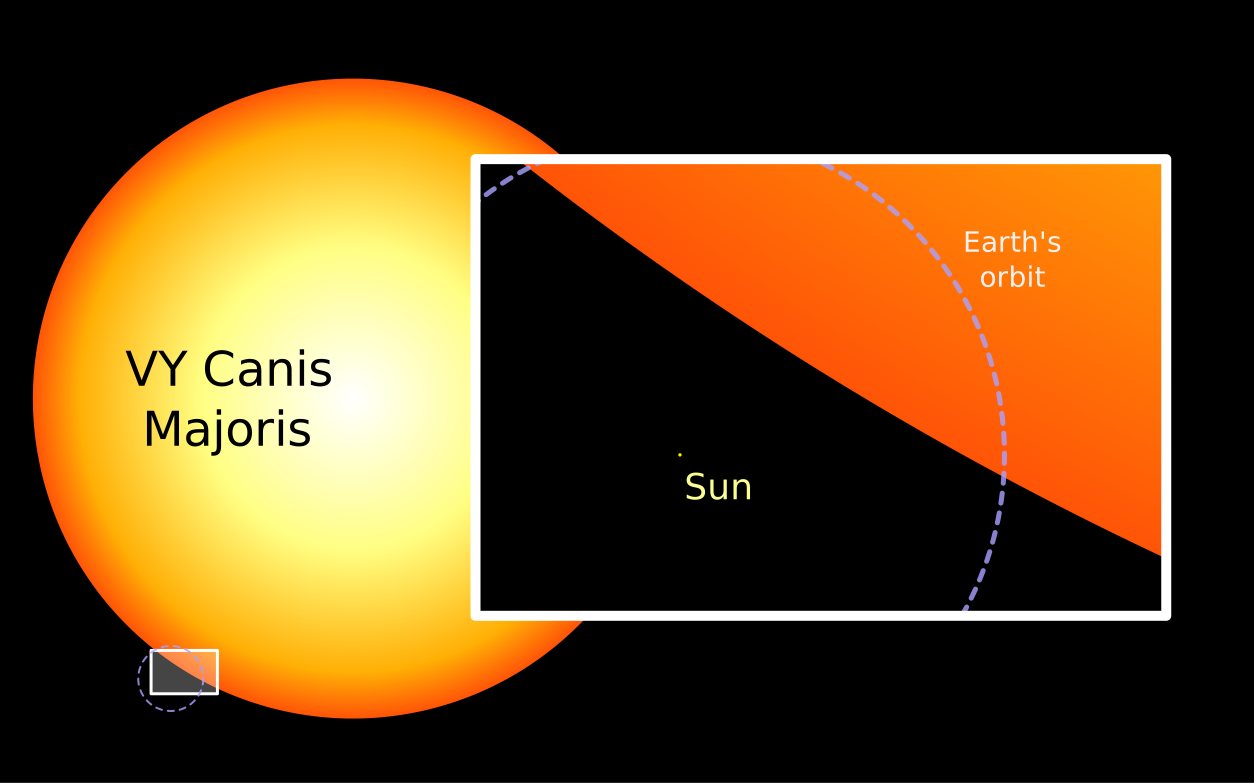
VY-CMa is classified as a hypergiant, meaning its larger than the most commonly taught "biggest star" the supergiant. At about 1420 solar radii, or 987,610,000 kilometers, flying at the speed of light it would take almost an hour to fly from its surface to its core, it would take less than a minute to do that in our sun. A star this size has problems though. To keep itself so huge it burns a lot more fuel than your average star like the sun, literally an Earth's mass of hydrogen and helium every few minutes. That means the star dies young, runs out of fuel faster. When a supergiant goes, we call it a supernova; a massive explosion as the core collapses and all the outer layers of the star are blown outward in one of the most violent outbursts of energy in the known Universe.      

But when a hypergiant goes, its a whole new ballpark. A hypernova makes you're average supernova look like a sparkler. The core and most of the inner layers of the star almost instantly collapse into a massive black hole. As the inner layers begin to collapse in on the black hole, it becomes overwhelmed by the sheer amount of mass it's trying to devour and starts releasing a ridiculous spectrum of gamma rays and various forms of Hawking Radiation. These waves carry outward on the huge mass of star layers that didn't get sucked into the core and travel outward. Models suggest that if VY-CMa went hypernova right now it would steralize every planet within 100 light years. Lucky for us, we sit pretty at about 4000 light years. When VY-CMa goes, quite possibly within our lifetime, we might get a bit more radiation than any other average day, but we'll be fine, and a new star will appear in the night, and day. The last time anyone on Earth observed a supernova was the Chinese centuries back, it was said to have outshone Sol even in the day. Imagine what a hypergiant could do.


Sunday, October 28, 2012

I Don't Have a Title

     So last week I promised to talk about something called Transcendance. Yup, don't know why I did that, forced myself to write about something in particular. Here we go.
     So last week I talked about the Fermi Paradox, where is everybody and all that. Check it out if you want to, just scroll down further. You'll love it, I promise. So where there is a problem in science there are also hypothesis, possible solutions. With a question like the Fermi Paradox, you have to account for why we don't see any big glowing signs. Some people like the idea that civilizations simply stop talking so loudly when they get smart, others think they close themselves off in giant bubbles called Dyson Spheres. One of the most interesting ideas is something a little more odd.
     What would be the ultimate freedom in a Universe like ours? Without getting all wishy-washy and philosophical its a pretty easy question; not being a "thing". How do you not be a thing? Well, a thing is something in this universe, something solid and with weight. If I ask: "which is a thing, a gluon or an elephant?" The answer seems obvious, a gluon is a tiny tiny tiny little thing, practically nothing at all, and elephant is big and solid. Humans are things, we have a mass, a size, a density, a specific energy output, ect...
      But if you lose your "thingyness", then you lose all the things that being a thing means. No more mass means you can zip around the universe at the speed of light without relativistic effects, and not having a solid body means you could go for a dip in a star if you felt like it. Sounds like science fiction right? Well it is.
     Basically transcendce is an idea, nobodies sure how to do it, but we have inklings, and we know what the end result should be. Its like knowing what type of cake you want to make but not knowing what you need to bake it. Transferring a human consciousness into an stable energetic matrix isn't exactly baking a cake, but you get the idea.
     Why bother with it? Well a lot of reasons. It's basically immortality, and the number one reason as always is just because its worth a shot. Thats how science works, if you can do it, awesome, congratulations  if not, you probably still learned plenty along the way.

Sunday, October 21, 2012

Planet Earth Calling the Universe, is Anyone Home?

     Silentium universi, literally Silence of the Universe, and another name for one of the most puzzling questions ever to face the astronomical society of the world: The Fermi Paradox. The math has always said the Universe should be teeming with life in varying stages of development, so the question is, where is everybody?
     The Paradox was so named after an informal discussion in 1950 where physicist Enrico Fermi brought up the subject. His conjecture was based on a mathematical probability model called the Drake Equation, which, when feed the proper data, will produce a rough estimate of the number of space-faring civilizations in our galaxy at this point in time. The exact values of certain points of data in the equation are constantly changing, such as the estimate of the average number of planets a star system might have or the type of star system, as certain types of binary systems are much less capable of sustaining planets in a stable orbit. The Drake Equation's results can come out to anywhere from 1,000 to 100,000,000 depending on the exact data used, but even using the smaller part of this range, a thousand space-faring civilizations should make noise, lots of it.
     Look at humans. We've been space-capable for just the last half-century, and yet even before that we were blasting radio and TV signals into space for the entire universe to hear. Hitler's opening speech at the 1936 Olympics, the first broadcast strong enough to leak into space, has already travelled outwards 76 lightyears. That's right, Hitler will be the first human any alien who's watching gets to see. The thought is, we're a young people, imagine what a far older civilization would send out, especially if they covered a few stars. An empire of that size should look like a bright "Right Here" neon sign, and yet our radio telescopes pick up nada.
     There are possible solutions though. What if the aliens didn't want to be found? Think Columbus and the Indians, hostile takeover of a less advanced people. If an advanced race were to show up in orbit they could easily wipe us out in one of many ways, then have our planet for themselves. So a species might be wise to stop broadcasting and keep all future communications on tight channels, make sure nobody could hear them. If that's the dominant mentality in this area of the Galaxy, we shouldn't expect to hear much.
     And then there's the Zoo Hypothesis, that a race of Superintelligent Galactic Police make sure nobody stops in and says "Hello" to us while we're still developing; like the Prime Directive from Star Trek. It might seem cruel to do such a thing, just leave us here to bomb ourselves into extinction, but maybe that's the point. If a species isn't capable of maintaining and prospering itself, or chooses the path of violence and conquer, what use would it be to a galactic community? Better to let the good ones fight there way up the ladder and sit back as the bad ones blow themselves to pieces.
     That's another idea to, they're all gone because they've manage to destroy themselves. Any species that develops nuclear power could destroy itself with relative ease, never to be heard again. Hell, we almost did it a few times. Wouldn't that be a nightmare, we finally get to space to find out we're the only ones who've managed to get that far, humans as the smartest beings in the Universe. Pray to whatever god you have that never happens, imagine the size of our egos.
     A final, less dismal idea is that we've simply come to our prime in a "Dead Zone", meaning we've just missed everybody. Empires might have risen and fallen while we drew pictures in caves, but we missed their phone calls, and now everybody's either dead, in a Dyson Sphere, or transcended. Next week I'll actually try to talk about what transcend means, it's not what you might think.
    All in all, that's a lot of text, if you got this far, congrats.

Monday, October 15, 2012

From the Desk of the Xenobiolgist

     Most people easily know what a biologist does for a living. But ask them what a Xenobiologist does and you'll probably get quite a few "huh?" and "what did you say?" responses. Someone who knows their root words might know that xeno means roughly "stranger". A Xenobiologist studies the biology of strangers, i.e. non-Terran species. Terran means things on Earth, in case I haven't covered that.
     So what might a Xenobiologist do? Well, one of their jobs would be to map out possible evolutionary lines that could emerge on foreign planets. I'll walk you through an example, something a bit more familiar than say Kepler 22b, we'll use good old Jupiter.
     Lifeforms residing on Jupiter would be called Jovians. Now as you may know, Jupiter doesn't have a surface. Then how could something live there you ask? Balloons. Really, big, balloons. Balloons stay aloft by using differences in pressure, you fill it with Helium, a gas lighter than air, it will float. You can do the same thing with living things to, it turns out. A Jovian might process compounds in the atmosphere for nutrients and break it down to lighter gases, using those to float. These things, call them Scoopers, would be big, absolutely huge. Imagine whale shaped creatures, floating around Jupiter's atmosphere, scopping up organic compounds as it lumbers around. It would spend its entire life at the mercy of the air currents, and probably never develop any level of Sapience because it would likely evolve in a low-intelligence herd line.
     Another theoretical creature, we'll call this one an Aeroraptor (it's not real, so we can have cool names), might be capable of powered flight. Technically speaking, Jupiter's atmosphere is filled with combustibles. It sounds silly, but in an environment like this it would be completely possible for a creature to evolve an organic type of jet engine. Like the Scoopers it would collect compounds as it moves, but it would use them to zip quickly around. This type of adaption would likely only evolve on carnivorous creatures, who need speed to ambush their prey in the big open skys. If an Aeroraptor evolved to be big, it would hunt by itself, and if it was small, it would likely hunt in packs.
     Of course these are only a few possible creatures, an environment as big as Jupiter with so many varying layers would have a very complex biosphere. It's fun to think of all the different creatures that could evolve in these environments, and thats a draw most Xenobiologists understand. There are billions of other planets, billions of other systems where unique and interesting species could evolve.

Monday, October 8, 2012

Cheap Rockets

     Anyone paying much notice to the news lately has likely heard about a little company called SpaceX. In May of this year SpaceX launched one of its Falcon 9 rockets to deliver its Dragon Capsule to the ISS. That flight was a test run, to make sure it could be done without any serious problems. The mission was a complete success, streamed live on NasaTV the entire day, thought with not nearly the press coverage our friend Curiosity got.
     SpaceX is a small private space company started in 2002 by Elon Musk, the creator of PayPal. Its goal is to act as a cheaper method of orbital payload delivery, particularly to the ISS, though Musk is interested in extending the company's reach farther into the solar system. They operate using three rocket designs, the Falcon 1, Falcon 9, and Falcon Heavy, and use the Dragon capsule with all three designs.
     Today (October 8th) was the first commercial payload mission for NASA, meaning they are shipping supplies up to the ISS. I've had a hard time finding the exact numbers, but as I've heard it the SpaceX system is nearly 1/10th as expensive as the system NASA has used for resupplies for the longest time, especially with the retirement of the Shuttle program.
     With the advent of these new private companies who are more than eager to do simple tasks like resupplying, it frees up NASA's hands for more ambitious projects, like Mars or a replacement for the Shuttle, something we desperately need.