Sunday, September 23, 2012

Bubbles in Space!

     Antimatter is neat stuff. If you have $60 trillion and can wait a year or two you can have a whole gram for yourself! What does said gram get you? Try three times the force of the Little Boy nuclear bomb dropped on Hiroshima in 1954. When a single particle of antimatter meets its matter counterpart, the resulting reaction converts both into 100% pure energy. If a third of a gram could level a city, what could you do with a metric tonne of the stuff? Blow up the planet? Ignite Jupiter? Or maybe...
     ...Power a Warp Drive! I'll be calling it an Alcubierre Drive, because Miguel Alcubierre was the man who worked out the physics, and he deserves more credit then he gets, but the idea would be completely familiar to any Trekkie out there. You take the space infront of you and crunch it down, while you expand the space behind you. The result is faster than light (superluminal, FTL) travel with absolutely no funky dilation. Typically when you talk about FTL and don't use a word like "hyperspace", you have a bit of a problem. If you could accelerate past the speed of light, ignoring energy limitations, time would literally flow backwards onboard your ship. Paradoxes galore!
     But thanks to Alcubierre, we might have a solution. The Alcubierre drive isolates the ship in a bubble of normal space time, so time would pass exactly the same inside as outside the "Warp Bubble". If you look at the picture first picture you can see a rough graphical representation of this. The flat grid is normal spacetime, while the z-axis represents a positive or negative shift in the "stretch" of space. On either side of the Bubble, everything is nice and flat, while the bubble itself compresses space (a negative movement in the z-axis) in front and expands behind it (a positive movement).
     You made it this far? Awesome! So back to that metric tonne of antimatter. Recent data collected by NASA's Advanced Propulsion department (often called "the Eagleworks", after Lockheed-Martin's Skunkworks advanced aircraft testing facility) has shed new light on Alcubierre's original mathematics. Originally it was estimated that a ship of the design Miguel had in mind would require a ball of antimatter the mass of Jupiter, not very feasible right? But the Eagleworks has found that by altering the math and design of the ship a bit, you can reduce the power requirements to about a metric tonne of antimatter.
     Now I'll admit, that's a lot of antimatter to produce, and considering its extremely expensive and extremely dangerous, it might not seem like the best idea. So why even bother thinking about it? Well, as my grandfather once told me; "some things a man should do simply for the sake of being able to say he did them".

Sunday, September 16, 2012

Destination: Europa

     Take a rocket to the Outer Solar System, hang a sharp right when you hit Jupiter (trust me you'll see it). Go on for about 600,000 kilometers and you'll arrive at one of the most interesting moons in all of Sol: Europa.
     The moon was first discovered in 1610 by Galileo Galilei and is one of the four original Galilean Moons. It was, at the time, thought to be the second farthest moon from Jupiter, though later observations by the Voyager probe showed four more inner satellites, making Europa Jupiter's sixth moon. The moon is about one fourth the size of Earth, having a radius of 1560 km, and orbits its host planet every three and a half days at an average range of 670,000 km.
     So why should you care about tiny little Europa? Two words will answer your question: Liquid Water. Evidence suggests that under a few kilometers of hard icy crust lies a massive planet-wide ocean. This ocean could very easily harbor all sorts of simple and complex lifeforms, protected from radiation via the ice above, instead of a typical atmosphere. Creatures that evolved here would likely rely on nutrients from thermal vents, similar to the ones found in the deeper parts of the Earth's oceans, and would have evolved completely different sensory organs then what we're used to. Creatures never exposed to visible light might "see" in electromagnetic fields, much like a shark's sense of electroreception (click to learn more). The search for extraterrestrial life might well lead us into our own backyard.
     Though no probe has ever specifically been sent to Europa, many have studied it as they passed by, including Pioneer 10 and 11, Voyager 1 and 2, Galileo, and New Horizons. Several missions to the moon have been planned over the years, but were cancelled for various reasons. In 2012, the ESA selected the Jupiter Icy Moon Explorer (JUICE) as a planned mission, with a launch date in 2022. JUICE is an orbiter, meaning while it will be able to collect a large amount of data on the moon, it won't be able to directly probe for life. For that we need something a little more invasive; like a nuclear-powered "melter probe". A probe of this type would melt/drill its way to the subsurface ocean, and then release one or more autonomous probes to scan for life and collect samples. The picture is an artist's concept of this method.
   

Sunday, September 9, 2012

A Nuclear Option

     Something not many people realize is that the scientists of the Manhattan Project weren't single-mindedly focused on creating the ultimate weapon. Some of them had alternate ideas for how such technology could, and perhaps should, be used. One such side project was the use of nuclear detonations to accelerate a spacecraft very rapidly to extremely high speeds, commonly called Nuclear Propulsion.

     Orion was the first craft designed in concept to use this method. The project was initiated in the late 1950s, lead by Ted Taylor and the physicist Freeman Dyson (a truly brilliant scientist who I will surely discuss at length in a later post).   The ship would be relatively cheap to propel compared to chemical rockets, but due to a nearly instantaneous acceleration of about 100 gees, there would be no foreseeable way for a human crew to tag along.
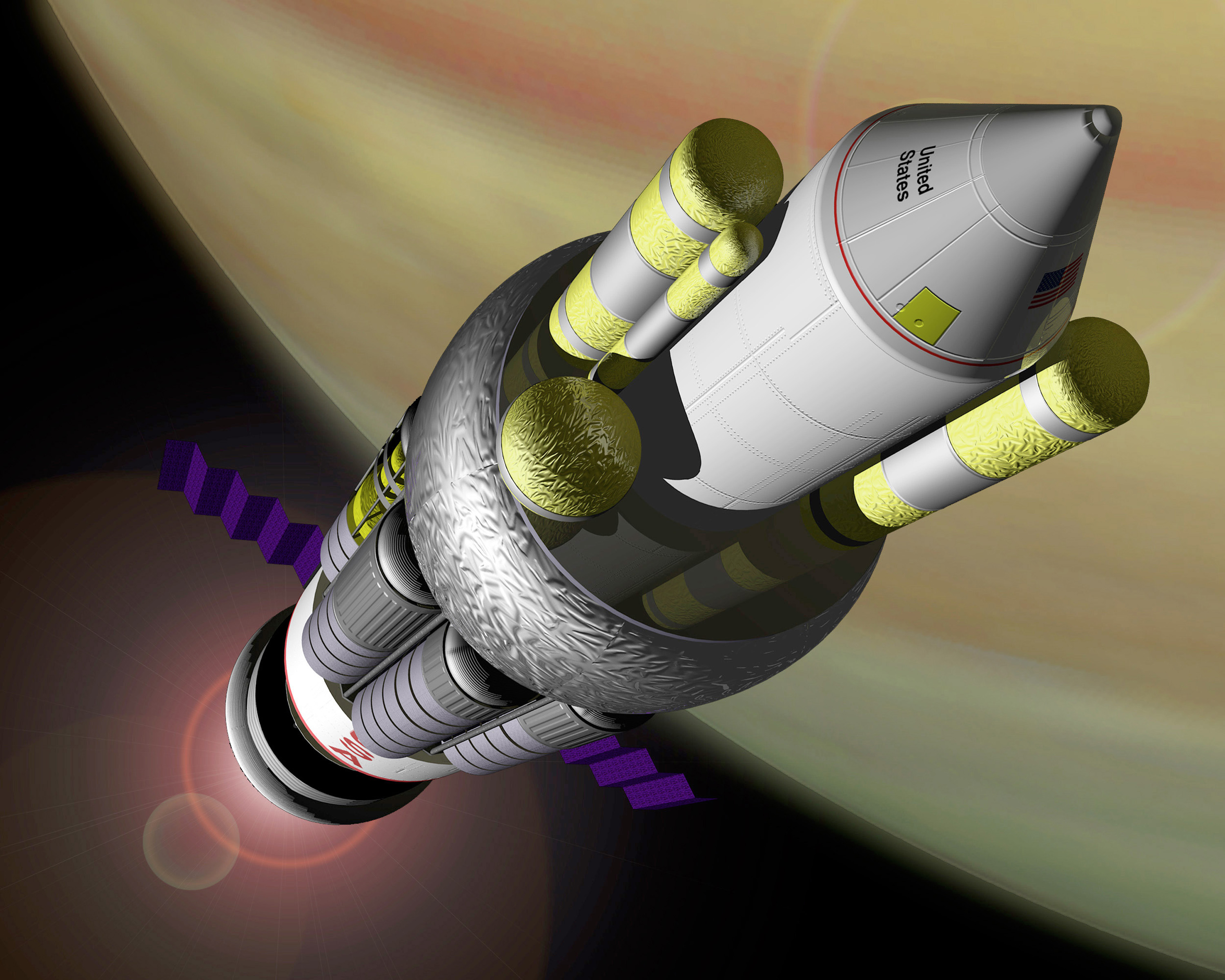
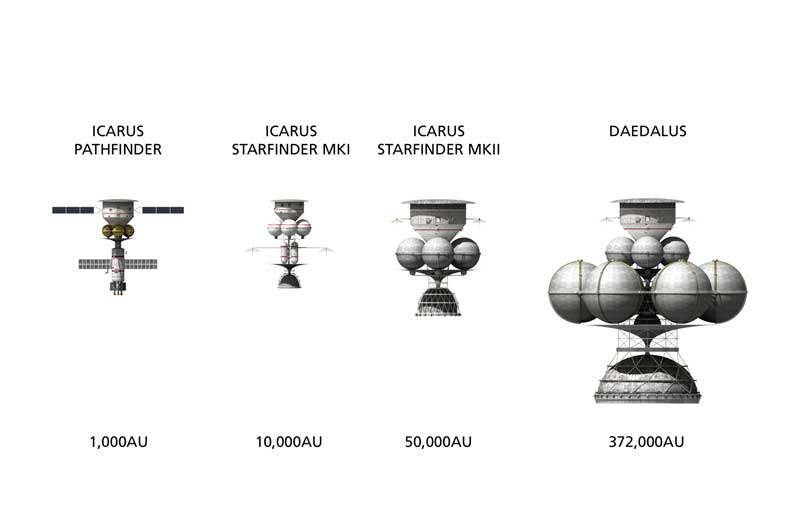
     After the project was scrapped in 1963 due to the Partial Test Ban Treaty, it was several years before any other craft of this type was seriously discussed. Finally, in 1973, the British Interplanetary Society conducted a study to design a plausible unmanned interstellar probe using current or near-future technology and engineering. The Project, and its hypothetical ship, were dubbed Daedalus, after the father of Icarus from Greek mythology. The craft would be about 190 meters long, have a max payload mass of 450 tonnes, and be driven by a Fusion Rocket. It was devised in two stages; the first would accelerate the craft to .071 c (7.1% of light speed) over the course of two years, while the second would reach .12 c just under two years after. At those speeds it would take only 50 years to reach Barnard's Star at about 5.9 light years away. The ship would also be escorted by a small flotilla of robotic drones and "wardens" responsible for scouting the space ahead and repairing any damage done to the craft during the trip.
     To this day Daedalus remains likely the most thoroughly designed interstellar craft in existence. If by some extreme stretch of the imagination the world could refocus some of its resources to building such a craft, it would be entirely possible for it to be completed in only a matter of decades (most of that time would be spent gathering its fuel). It's really very interesting that technology originally conceived a quarter century ago still prevails as one of the best methods to advance humanities sphere of influence in the stars.

For more information on Daedalus, please click the link and read the very interesting paper on it: http://www.icarusinterstellar.org/wp-content/uploads/2012/05/ASPW2010-1.pdf

Curiosity


     In recent weeks there was quite the buzz about a little Rover that found its way to Mars. The rover was call the MSL, or Mars Science Laboratory, but was more commonly known as Curiosity. It was launched in August of last year (2011) and touched down August 6 at 1:32 a.m. 
     The rover really is an amazing piece of machinery. At about the size of a small car, it's nearly twice as large, and carries twice as much equipment, as its predecessors Spirit and Opportunity. Another cool feature: Curiosity is nuclear. Unlike past rovers, which relied on solar cells, making them useless in the night or long Martian winter, this rover is powered by the decay of a small amount of plutonium which produces about 110 watts of constant electricity and heat used to warm some of the rovers systems.
     Curiosity's main mission is to study Mars, but its secondary goal is to assess the possibility of human settlement of the Red Planet. The data it collects will be of use to NASA if and when we ever reach that point, though its more likely to be of use to private companies who can put a man on Mars a lot faster than NASA can.
     Another thing of particular interest with this rover was its popularity. For several weeks leading up to its landing it was hard to find a news channel that didn't have at least one segment on it every day. The actual entry and landing (shown in the video) was streamed live on almost every major network, and even Microsoft's Xbox 360 offered a live feed from the command center. The day after the internet exploded with clever memes and comics about the landing. But where was all the hype when Juno or Kepler were launched? Even previous Mars missions didn't draw quite so much attention. 
     Perhaps it's a sign that the general public has reacquired some of its lost passion for exploration, and I really hope that's the case. NASA has really been lacking for public support in the past decade, and Curiosity could provide just the boost they need.