Sunday, November 18, 2012

Speak Softly and Pilot a Big Ship

     Let's say you wanted to build a ship. It has to be a big ship, big enough to carry and sustain a pretty big number of people, maybe 1000 or so people of various ages and occupations. It has to be able to go decently fast too, say fast enough to make the trip to Mars in a month. Why would you need such a ship? Well I don't even know why anyone in their right mind would ask this question but I can supply an answer; because science.
     Well in reality it would be scientific revolution, and a cultural one. Not only would we have amazingly quick and easy access to Mars and other nearby planets, this ship would be, in essence, a moving space station. Something of this magnitude could park in Earth orbit for a month, trading data and resources, then take off to Mars, maybe stopping at the Moon along the way. It would also make launching probes a lot easier. Probes could be accelerated with the ship and released during turnaround (when a ship is at max velocity, about halfway through the trip, it turns around and burns in the opposite direction to bring it to a relative velocity of zero) toward its intended target; much cheaper since its incorporated into an existing system.
      More science fiction right? Well no, not really. We have everything we need to build this type of ship right now. Now granted, it would cripple the United States economy to the point of turning us into a third world country, but who says this is a job for just us? If this became a UN project, it could be done feasibly without killing anyone's economy.
     Something of this size needs a pretty big engine. There are all sorts of possibilities, an ion engine, a small nuclear pulse engine, or even slave the old engines from the Shuttles, for a taste of nostalgia. Any way you spin it, those engines will need power, and a lot of it. Obviously we can't use petrol, we shouldn't be using it here on Earth at all, using it in space would be equally or more idiotic. You could use a fission generator, but even those would be dirty and a big problem to keep safe for the people riding along. Imagine flying through space in an airtight can with a nuclear bomb behind your seat. Not a pleasant thought right? So what does that leave us? Tokamak. Magnetically accelerated plasma spun around a toroid until fusion is achieved. It might not sound like it, but it's actually a lot safer than a typical fission reactor, and a lot more powerful.
     So now that she's got some engines, we can worry about the people. How do you house that many people "comfortably" in a ship. Well there are quite a few solutions. While the ship is moving at a constant velocity (when you're in your car moving down the highway, you don't experience any forces, you only feel that pull when you're speeding up or slowing down) all you have to do is spin it. Whether you spin the whole ship or just a small ring for habitation, its absolutely necessary to keep those people used to gravity. People can survive in zero gravity indefinitely if needed, but if they did that, they'd never touch ground again. A child born in zero-gee would be killed by the gravity on the surface of Earth.
     It seems like a frivolous idea, and in some ways it just might be. But all I've ever needed to convince myself was the idea of seeing this ship built in orbit. Imagining the live video feeds as this ship forms, watching with the world when she fires up her engines, holding my breath when the Tokamak is lit. Something like that would change us as a people.

Monday, November 12, 2012

Schrödinger vs High School Physics Teacher

     One of my favorite classes I took last year was the only physics course offered by my school. It was an interesting class, and I knew enough about any given subject to banter with the teacher. The biggest problem I, and many other physics oriented people I found out, have with high school physics courses is that it's old. In a typical course, no theory or idea created after the late 1800s is talked about. Mainly the classes focuses is on Newtonian physics, the study of "big things" moving. Some lucky students (not myself) get to learn about a bit of Quantum Mechanics at the end of the course, but even then its a ridiculously small section.
     250 years is a long time. Hundreds of great scientists have lived and died in that time, thousands of new pieces of mathematics came into being, there were entire revolutions in the way we think about things like photons and atoms. Teaching a physics course but skipping 250 years of physics is like teaching biology without modernized evolutionary theories or even an idea of DNA, or history without quite a few presidents and both world wars. The biggest issue people seem to have is that they find this new stuff daunting. Physics is supposed to be hard, thats how culture thinks of it, so why try teaching students about quarks when they struggle with calculating velocity. But physics doesn't have to be hard, and its certainly not impossible to teach to high school students. Look at myself. I have only ever taken that lone class with a high focus on kinematics. All my knowledge comes from haphazard scanning of data and articles on the web, imagine what an actual class might accomplish?
     That's one of the biggest problems we have. Kids today who take a high school physics course and roll out to college with the intention of solving kinematics equations, only to find this intense language of maths and calculus beyond their grasp. Why? Because high school physics does an awful job showing what real physics is. Newtonian models, the "big stuff" math has been set aside today for Quantum World to be examined, and considering practically no high school classes go into any depth on that subject, there lies an obvious problem.
     The video below is from a group of physicists in the UK who are discussing how physics classes in the UK are taught to students. The system across the pond is almost identical to ours, and these educated men find humor in their old notes from these classes.

Monday, November 5, 2012

You Wanna Talk About Firepower


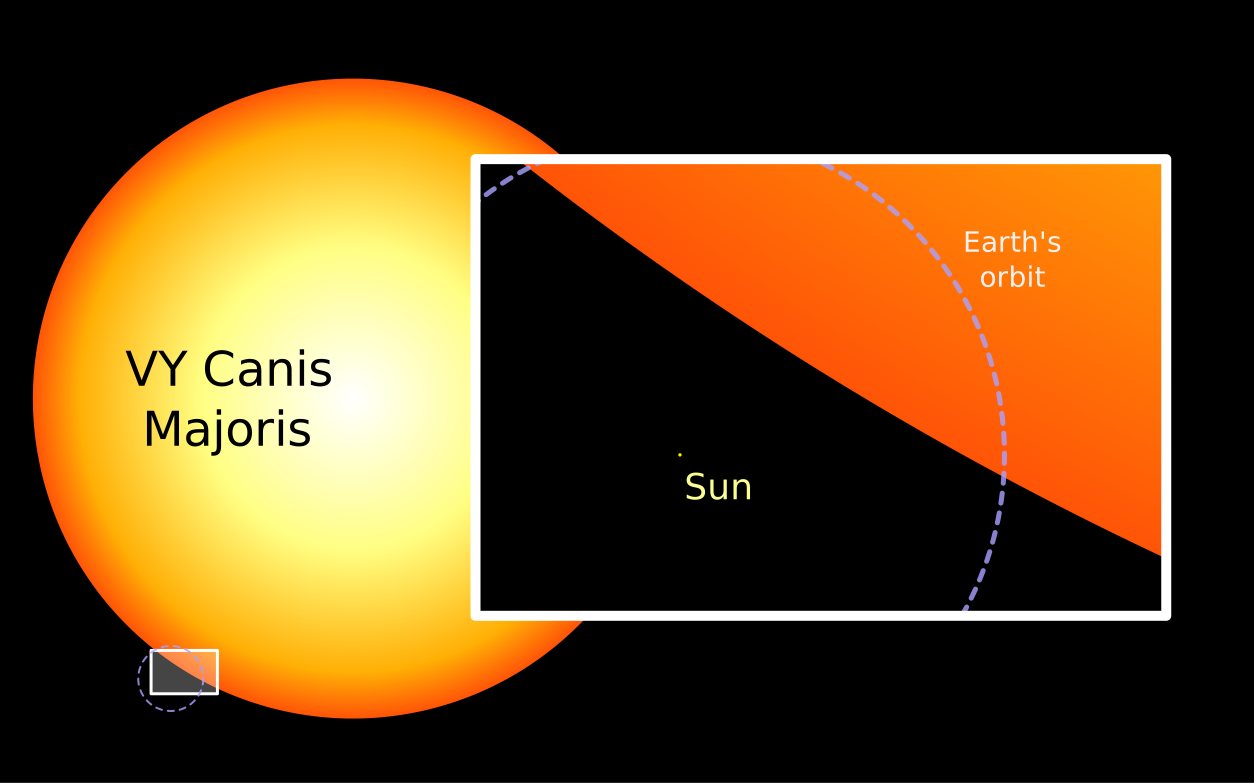
     There exists, in the depths of space, a monster. A giant with an incredibly short, yet especially volatile life. A monster powerful enough to sterilize the surface of planets for hundreds of light years in its death-throws  and even after death it leaves behind a lethal reminder of just how powerful it was. If you thought the sun was big, wait until you learn about the mighty VY Canis Majoris.     

The star was first observed in 1801 by Jérôme Lalande, and until relatively recently many astronomers believed it to be a multiple star system, as they could not conceive of a single star so large. It wasn't until about 1957 that anyone was able to confirm that VY-CMa was a solitary star. Distance measurements were equally perplexing. Typically to find a stars distance we observe its position in the night sky at two separate dates, about six months apart. The distance its position has changed can be input into a equation to determine its distance trigonometrically. With VY-CMa though, this change, called the Parallax angle, is very small and thus for the longest time lead to a very broad range of possible distances. And in the case of this star, knowing how far way it is is very important, life and death of the human species as a whole important.     

VY-CMa is classified as a hypergiant, meaning its larger than the most commonly taught "biggest star" the supergiant. At about 1420 solar radii, or 987,610,000 kilometers, flying at the speed of light it would take almost an hour to fly from its surface to its core, it would take less than a minute to do that in our sun. A star this size has problems though. To keep itself so huge it burns a lot more fuel than your average star like the sun, literally an Earth's mass of hydrogen and helium every few minutes. That means the star dies young, runs out of fuel faster. When a supergiant goes, we call it a supernova; a massive explosion as the core collapses and all the outer layers of the star are blown outward in one of the most violent outbursts of energy in the known Universe.      

But when a hypergiant goes, its a whole new ballpark. A hypernova makes you're average supernova look like a sparkler. The core and most of the inner layers of the star almost instantly collapse into a massive black hole. As the inner layers begin to collapse in on the black hole, it becomes overwhelmed by the sheer amount of mass it's trying to devour and starts releasing a ridiculous spectrum of gamma rays and various forms of Hawking Radiation. These waves carry outward on the huge mass of star layers that didn't get sucked into the core and travel outward. Models suggest that if VY-CMa went hypernova right now it would steralize every planet within 100 light years. Lucky for us, we sit pretty at about 4000 light years. When VY-CMa goes, quite possibly within our lifetime, we might get a bit more radiation than any other average day, but we'll be fine, and a new star will appear in the night, and day. The last time anyone on Earth observed a supernova was the Chinese centuries back, it was said to have outshone Sol even in the day. Imagine what a hypergiant could do.