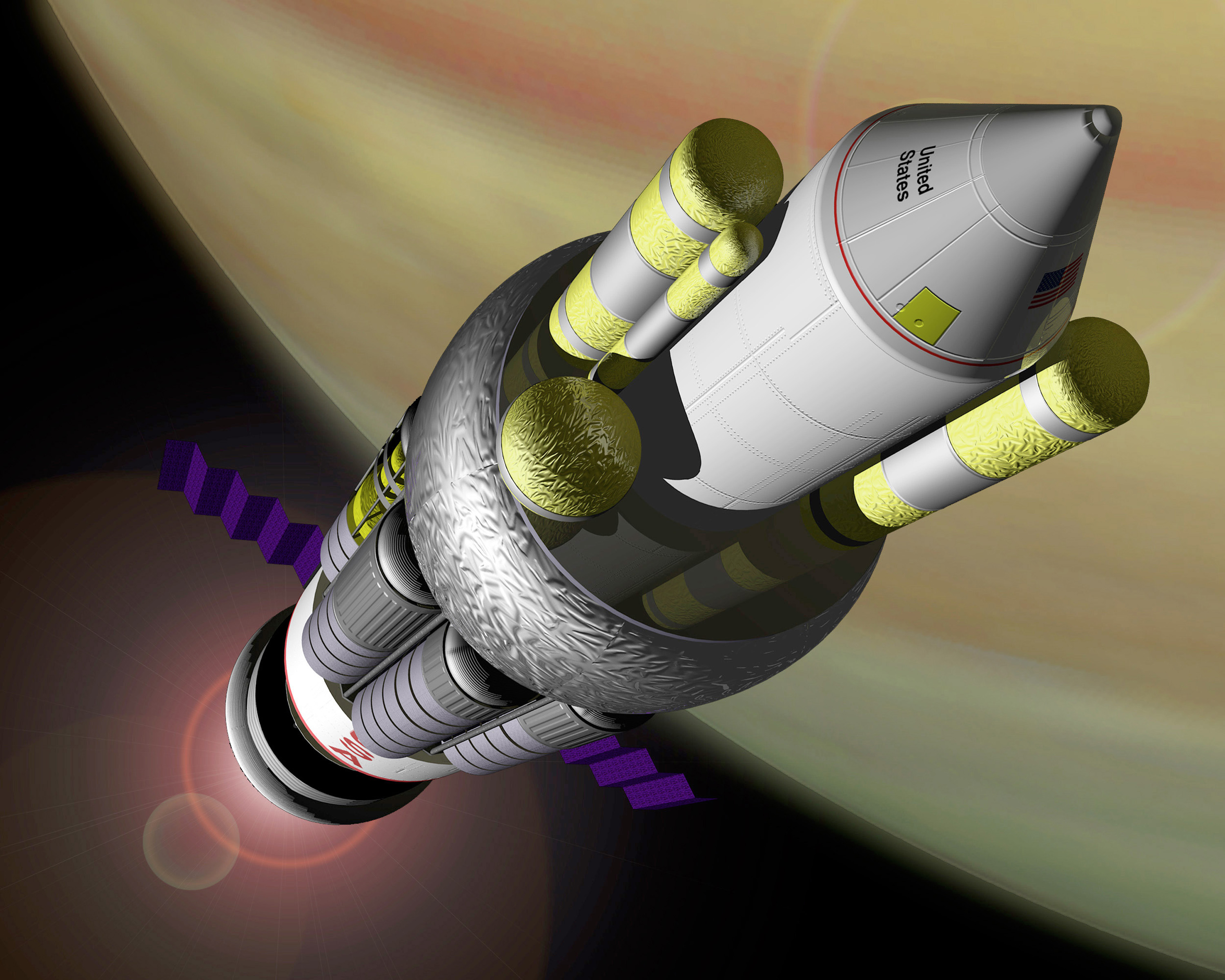
Something not many people realize is that the scientists of the Manhattan Project weren't single-mindedly focused on creating the ultimate weapon. Some of them had alternate ideas for how such technology could, and perhaps should, be used. One such side project was the use of nuclear detonations to accelerate a spacecraft very rapidly to extremely high speeds, commonly called Nuclear Propulsion.
Orion was the first craft designed in concept to use this method. The project was initiated in the late 1950s, lead by Ted Taylor and the physicist Freeman Dyson (a truly brilliant scientist who I will surely discuss at length in a later post). The ship would be relatively cheap to propel compared to chemical rockets, but due to a nearly instantaneous acceleration of about 100 gees, there would be no foreseeable way for a human crew to tag along.
After the project was scrapped in 1963 due to the Partial Test Ban Treaty, it was several years before any other craft of this type was seriously discussed. Finally, in 1973, the British Interplanetary Society conducted a study to design a plausible unmanned interstellar probe using current or near-future technology and engineering. The Project, and its hypothetical ship, were dubbed Daedalus, after the father of Icarus from Greek mythology. The craft would be about 190 meters long, have a max payload mass of 450 tonnes, and be driven by a Fusion Rocket. It was devised in two stages; the first would accelerate the craft to .071 c (7.1% of light speed) over the course of two years, while the second would reach .12 c just under two years after. At those speeds it would take only 50 years to reach Barnard's Star at about 5.9 light years away. The ship would also be escorted by a small flotilla of robotic drones and "wardens" responsible for scouting the space ahead and repairing any damage done to the craft during the trip.
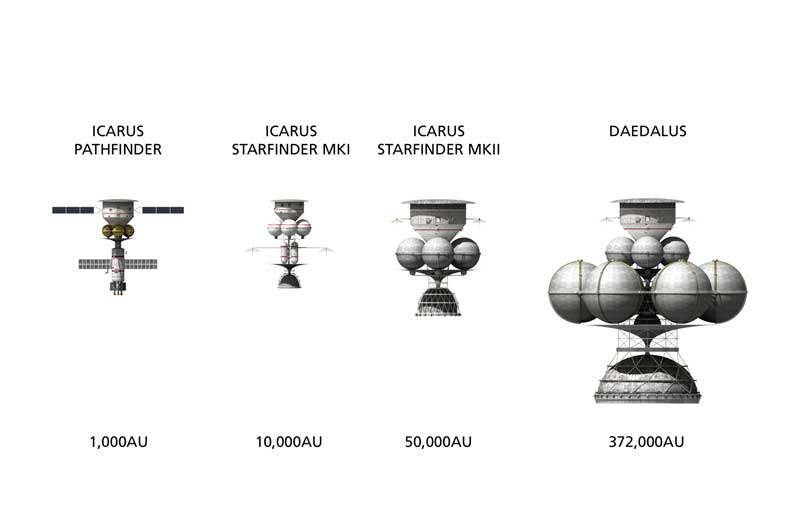
For more information on Daedalus, please click the link and read the very interesting paper on it: http://www.icarusinterstellar.org/wp-content/uploads/2012/05/ASPW2010-1.pdf

Right on Seth
ReplyDeleteThis is some interesting stuff, and also makes me think about how advanced traveling will become in the future.
ReplyDelete